Transcript
This transcript was auto-generated from the video and was filtered and modified for readability.
KWIN ETF Webinar — Cleaned Transcript
Cross-listing of the KraneShares Wahed Income ETF (KWIN) on the Abu Dhabi Securities Exchange (ADX)
Opening Remarks — Amr Amin (ADX Corporate Relations)
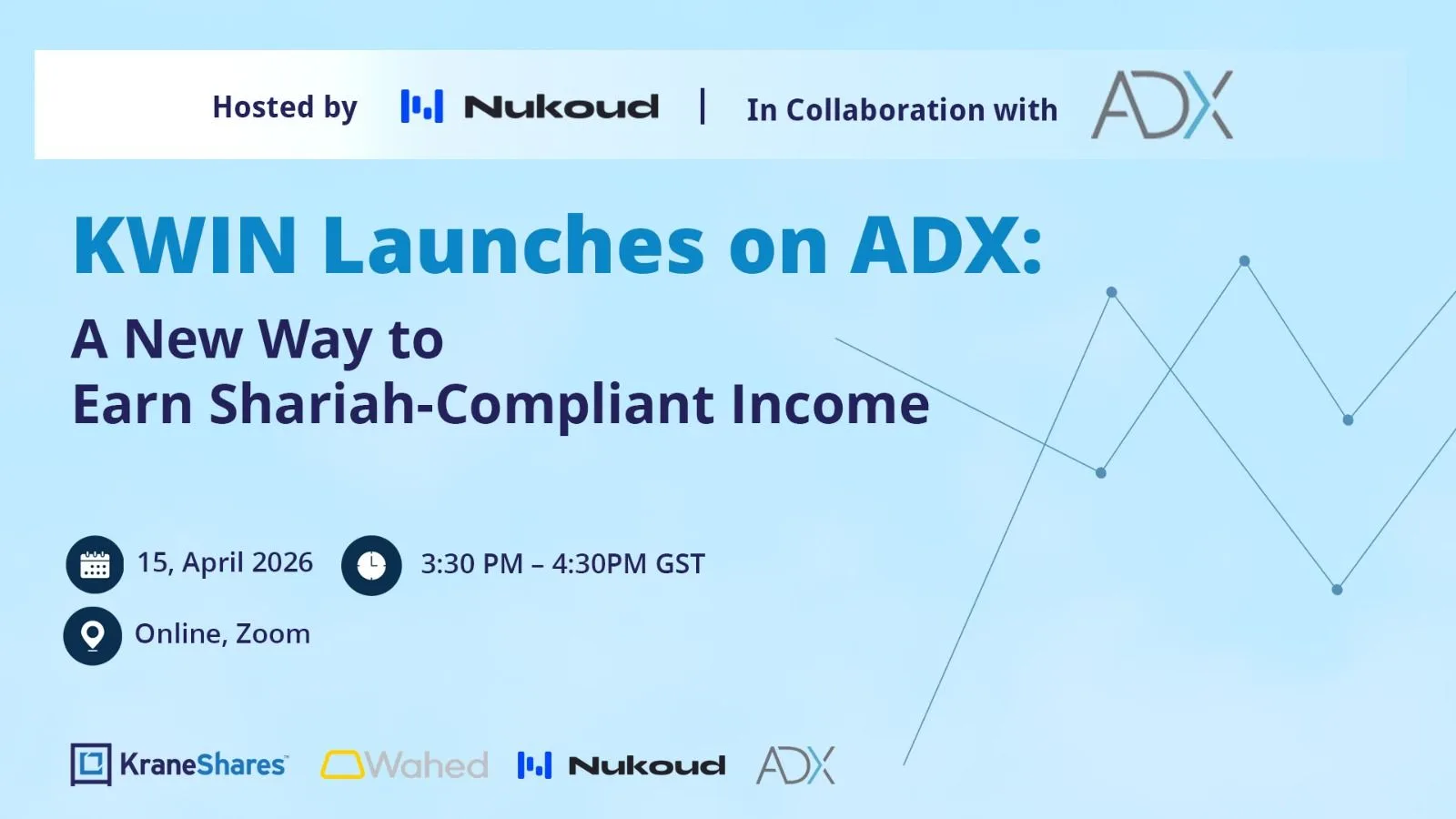
Salam alaikum. Good afternoon everyone, and thank you all for joining us today. We're delighted to welcome you to this session introducing the KraneShares Wahed Income ETF, or KWIN, which is now cross-listed on the Abu Dhabi Securities Exchange.
My name is Amr Amin, and I lead corporate relations at the ADX, where we work closely with listed companies and market participants to enhance investor engagement and support the continued development of Abu Dhabi's capital market.
Today's discussion is designed to give you a clear and practical understanding of this newly launched product — what it is, how it works, and how it may fit into an investor's portfolio, particularly for those seeking income within a Sharia-compliant framework. As many of you will know, the ETF landscape continues to evolve globally, and we are seeing increasing innovation in income-generating strategies. KWIN represents an interesting and innovative addition to the ADX product offering, combining global ETF structuring expertise with Sharia-compliant investment principles.
Our goal for today is to keep the discussion accessible, practical, and informative — whether you are already familiar with ETFs or exploring them for the first time.
Before we begin, a couple of quick housekeeping points: the session is being recorded and will be shared after the event. If you have any questions during the discussion, please submit them through the Q&A function, and we will aim to address as many as possible during the conversation as well as toward the end of the session.
I'm joined today by an excellent panel of speakers representing different parts of the ecosystem behind KWIN: Ibrahim Sheikh, Principal at Wahed, and Anthony Sassine, CEO of Nukoud and Oceane Invest. Before we dive in, I'd like to give each of our speakers a brief moment to introduce themselves.
Speaker Introductions
Ibrahim Sheikh (Wahed): Thanks, Amr, and thank you everyone for joining. I'm Ibrahim Sheikh, Principal of Global Investments at Wahed, where I oversee global portfolio allocations and new fund mandates. My background spans global mutual funds, sovereign wealth funds, and private wealth. Thanks again for having me — I look forward to the session.
Anthony Sassine (Oceane Invest / Nukoud): Thank you for joining, and thank you to ADX for collaborating on the KWIN webinar and for facilitating the launch of KWIN. My name is Anthony Sassine, and I'm the CEO of Oceane Invest, which is the market maker handling the KWIN listing and the IOP. I'm also the CEO of Nukoud.com, a platform to promote and generate ETF news in the region for local investors — starting from the region outward and then back into this region. Thank you all.
Setting the Scene: ETFs and the GCC Ecosystem
Amr: Anthony, for investors who might be newer to ETFs, how would you simply explain what an ETF is? And can you provide some context on the ETF industry in the GCC and how Nukoud and Oceane are looking to support this ecosystem?
Anthony: Absolutely. The ETF is a major financial innovation that emerged in the 1990s and really exploded in the 2010s and 2020s. Today, ETFs have more than $20 trillion in assets globally, which is massive and growing every year. One out of every three shares traded on the New York Stock Exchange is actually an ETF, so they're taking market share, in terms of volume, away from stocks.
ETFs are very important for institutional clients as well as retail clients. People manage their wealth and portfolios and invest in opportunities that retail investors did not have access to 5 or 10 years ago. The innovation started simply with tracking the S&P 500 — SPY, one of the first ETFs launched in the 1990s. Instead of having to buy all 500 stocks individually, you just buy SPY and get exposure to all 500.
That innovation evolved significantly into sector ETFs, into bonds, into thematic ETFs, and now we're seeing derivatives-based ETFs, Sharia-compliant ETFs, leveraged ETFs — you name it. Through that wrapper, you can have exposure to almost anything globally: any sector — AI, US tech, the GCC — or to a broad index that you can put money into every week or every month for retirement or long-term growth.
When I started coming to the region four or five years ago, we were surprised that ETFs weren't as prominent here as they are in the US, Europe, and Asia. The market was around $1.5 billion in assets. That's why we set out to create the two companies. Oceane helps the ecosystem promote ETFs and promote liquidity. So far, we've been able to lower the cost of trading for investors. For ETFs to trade, you need a market maker in the back end providing the quotes, and it's very important for investors to watch spreads, because that's the cost of trading. With Oceane, we have a team of market makers from the US and Europe who provide good transaction costs for investors.
We also created Nukoud.com because we realized that education and ETF news were lacking in the region. Through Nukoud, we collaborate with many global leaders — especially ADX, which has been at the forefront of this revolution — and with Waystone and other companies, to bring ETF news and education to the region and make it easier for local investors to learn about both GCC ETFs and the global ETFs they own.
It's been a good journey. In December 2025, during Abu Dhabi Finance Week, we cross-listed the first two ETFs from the New York Stock Exchange to the Abu Dhabi Securities Exchange — a major milestone. These were significant ETFs: KWEB, which is a $9 billion China ETF, and KRBN, which invests in carbon credits. Both began trading on ADX on December 10th in AED, allowing local investors to access them during local time zones.
Today, we're cross-listing two more very innovative ETFs. We're excited about KWIN — Wahed and KraneShares are providing local investors with a way to generate income outside of sukuk in a very innovative way. I believe it's the first Sharia-compliant options income strategy. We also have AGIX, which is listing tomorrow. AGIX is interesting because it can invest in both public and private AI companies — the likes of NVIDIA and Microsoft, which we all know, but also the likes of SpaceX and Anthropic. The fund currently has 7% in SpaceX and Anthropic, so by buying that fund, you immediately have pre-IPO exposure to these very important companies. Pre-IPO access historically required jumping through many hoops and broker connections, and was mostly open to institutional clients — but now this will be available on ADX.
We're very excited about the ETF market in the region and happy to collaborate with ADX, Wahed, KraneShares, and other asset managers to bring innovative strategies to the GCC.
How the Entities Came Together
Amr: Before we discuss KWIN itself, could you explain how these different entities — Oceane, Nukoud, KraneShares, Wahed — came together to create KWIN?
Anthony: I can speak about KraneShares, which is my previous company — that's how this all started. KraneShares is a global asset manager based in New York with about $10–11 billion in assets. The company started by giving US investors access to China through KWEB, which is the biggest China fund and is now listed on ADX. After giving access to China, the company began doing more innovative work in climate and alternatives, and that's where KWIN came together. Wahed and KraneShares teamed up to bring a unique fund to the US, Europe, and now the Middle East. I'll let Ibrahim speak to Wahed's side.
Ibrahim: Thanks, Anthony. At Wahed, our two focus areas in investments are funds and advisory portfolios. We have a client base of over 500,000 clients as part of our robo-advisory. We were the first company to list two Sharia-compliant ETFs on the New York Stock Exchange, and those funds are now also on the London Stock Exchange — and in future, on the ADX as well.
In terms of AUM, the company manages over $1.2 billion in Sharia-compliant assets. The differentiating factor for Wahed is that we are an out-and-out Sharia-compliant company, not a window of a conventional company catering to Islamic finance. In the fintech space, Wahed is perhaps the leader in client base and AUM when it comes to managed portfolios and funds.
Our partnership with KraneShares is a step forward in the evolution of the industry — into funds that are strategy-based and move beyond the equities-only Islamic ETFs that are prevalent today. Something we did back in 2017 on the New York Stock Exchange has grown into multiple funds across multiple regions.
What Is KWIN?
Amr: Back to KWIN itself — what exactly is KWIN, and what is it designed to do from an investor's perspective?
Ibrahim: If we look at slide four, which shows the growth of ultra-short bond portfolios and derivative income ETFs, you'll see that since the rate-raising cycle began across economies, a lot of capital moved into money market and ultra-short bond funds. The graph really takes off during the rising rate cycle from 2022 onwards.
Derivative income ETFs are slightly more complex strategies that try to derive value out of a particular structure by managing risks on both ends — as you'll see with KWIN — and they have also taken off. There are about 212 ETFs now that use derivatives-based strategies, with around $146 billion in AUM, which is tremendous in scale.
KWIN sits within this category. The difference between most other derivative-based strategies and KWIN is that the market direction risk that exists in other ETFs is largely removed in KWIN — the strategy is constructed to be market-neutral. When we go into the specifics, you'll see that directional risk is largely reduced. A market-neutral strategy is constructed using exchange-traded options contracts, and the trade-based strategy is constructed in a way that's also Sharia-compliant.
In a nutshell, the value proposition KWIN brings is an income-based strategy that takes out market directional risk and offers a low-volatility option for investors to generate income.
Anthony: Options-based strategies have become a huge driver of growth and innovation in ETFs. This started about two years ago and is now happening across the board. Essentially, you're harvesting the premium on options to drive income, and when there's volatility, the premium is higher.
The first major one was JEPI from JP Morgan — a $20–25 billion fund where JP Morgan was selling covered calls on US companies. Now we're seeing this happen on Bitcoin, on specific stocks, and for the first time, with Wahed, we've packaged it into a Sharia-compliant product that neutralizes the movement of the underlying stocks and gives investors the ability to earn income on a yearly basis. They're expecting close to 5% income, which is quite different from sukuk. This is very innovative for the region.
James Maund Joins (KraneShares)
Amr: We're now also joined by James Maund, Head of Capital Markets from KraneShares. James, would you take a moment to introduce yourself?
James Maund: Sure — and apologies for the technical glitches that prevented me from joining earlier. I'm James Maund, Head of Capital Markets at KraneShares. I oversee all relationships with exchanges, market makers, and APs who create shares of our ETFs, as well as overseeing all day-to-day portfolio management and trading across all KraneShares funds globally. Very excited to speak with everyone today about KWIN.
What Cross-Listing on ADX Means
Amr: James, what does it mean for KWIN to be cross-listed on the ADX, and why is that relevant for investors in our region?
James: A few reasons make this cross-listing exciting, unique, and powerful for investors. KWIN is a US-listed ETF that launched a few months back and has been very popular with investors due to the unique nature of Sharia-compliant income, which I'm sure Ibrahim and Anthony have covered.
Cross-listing in Abu Dhabi is exciting for everyone at KraneShares and for our investors. It allows access to local investors in the UAE, and it provides access during another segment of global market hours. In addition to having the exposure available to trade during US Eastern Time hours, having local UAE hours available is a huge advantage — investors can trade the exposure during those hours and have local-currency-denominated shares. We're grateful and excited to have the cross-listing on ADX.
Yield and the Investment Case
Amr: One of the key points of interest for investors is income. What kind of yield is KWIN targeting, and how should investors think about that compared to more traditional instruments like sukuk?
James: Happy to take that. It's generally the risk-free rate — typically the US Treasury rate — that is embedded in the options construct we're invested in. So something on the order of 4% in the current rate environment. Rates can fluctuate, but currently we're realizing returns in the high 3s to low 4 percent annually, which is a huge advantage over sukuk yields. As rate regimes change over time, those numbers will fluctuate, but in a way that should continue to be very competitive versus other acceptable Sharia-compliant instruments.
Amr: We have a question in the Q&A: how does this product compare with the SPDR S&P 500 Sharia fund?
James: Sure. It's actually a totally different exposure. The SPDR 500 is designed to track the performance of the S&P 500 index with a Sharia overlay, whereas KWIN is designed to generate an income-type experience for investors without taking any significant market risk. KWIN is more of a cash investment vehicle — something that will generate a yield consistent with the risk-free rate available in the US — versus providing market exposure and market risk to the Sharia-compliant version of the S&P 500. They're significantly different in that regard. KWIN is essentially a cash investment, similar to investing in US Treasury bills, rather than a vehicle providing exposure to large-cap US equities.
Ibrahim: I'd like to add a couple of points on yield and the comparison. The fund is focused toward being part of the fixed income and low-volatility money market sleeves of portfolios, rather than the equity sleeve. We have a slide listing the constituents and their annualized yields. The portfolio is made up of large-cap US bellwether names — Adobe, Amazon, Tesla, Lululemon, CrowdStrike — most of which are recognizable. You'll see the annualized yields currently being generated on these, gross of fees and subject to change as rates move. We average between the late 3s and early 4s on a net basis, and up to 5% on gross.
The strategy is very different from SPDR S&P 500, which exposes you completely to the price movements of the underlying equities. With the options layered onto these securities in KWIN, the directional market risk is neutralized. If you look at the since-inception NAV volatility of the KWIN fund on the New York Stock Exchange, it's less than 1%, versus close to 16–17% on SPDR S&P 500. It's a different class of instrument altogether.
How KWIN Generates Income — The Mechanics
Amr: Can you explain in simple terms how the ETF generates income?
James: The fund holds a basket of large-cap US equities that are Sharia-compliant, and it also holds an options combination — an options overlay — on those equities. For each underlying stock, we are long a put and short a call on that same stock. The result of that combination — short call, long put, and long the underlying stock — is a delta-neutral position. It eliminates the market risk on the underlying stock.
The goal and result of holding the stock plus the options combination is to extract the financing element of the options. Options have a few different components: one is the underlying stock exposure, which is neutralized by the combination of the two options positions and the stock. They also include elements related to time value and implied volatility.
What this strategy boils down to is extracting the time value element of the options combination in the form of a premium that the fund earns when we put on the position. We use quarterly options. At any given time, the fund holds options up to three months from expiration. What you're extracting in terms of value is the value of those three months of financing of the option.
The result is again a cash-like vehicle. It's a delta-neutral position with no market risk. The benefit of extracting that time value — realizing the value embedded in options for that time element — comes into the fund as options premium when it puts on a new tranche of options.
Sharia Compliance
Amr: Ibrahim, can you help explain the mechanics of an Islamic ETF? How is the strategy interpreted from a Sharia perspective?
Ibrahim: At its core, the strategy is Sharia-compliant in two aspects. For any investment strategy to be Sharia-compliant, you need both the underlying assets to be Sharia-compliant and the manner in which the strategy is implemented to align with Sharia principles.
The underlying instruments are screened for their business activity. The strategy excludes any companies involved in gambling, alcohol, tobacco, or adult entertainment — common across faith-based and value-based investing. Unique to Islamic investing is a further screening for financial ratios to ensure no company in the portfolio is taking on excessive amounts of conventional debt to fund its business.
In KWIN's case, the strategy is fairly straightforward, and James has described the instruments and positions used. The way Sharia interprets this: the fund begins by purchasing Sharia-screened equities and holding them in custody — so the strategy is asset-backed. At the same time, it agrees a fixed sale price for a future delivery date, using exchange-listed contracts (the long put and short call) as purely operational tools to give effect to a deferred sale. They are not used for speculation, and there is no open-ended optionality.
The two Sharia objections to options are gharar and maysir — which loosely translate to ambiguity and speculation (elements of gambling). With the structure created here, it is a fixed-price deferred sale contract with no element of speculation, and nothing is being sold that the fund does not already own — it's asset-backed.
From a Sharia standpoint, the economic substance of the structure is that of bay' mu'ajjal — a fixed-price deferred sale — which is a classical and well-established form of trade under Islamic principles. Any outcome from the strategy comes from the difference between the purchase price of the stocks today and the agreed sale price at delivery (the strike plus the premium aggregated would form the sale price of the security). It is entirely driven by commercial sale activity, not by lending or interest. To characterize the strategy: it uses modern market tools to implement a traditional Sharia-compliant trade structure.
Amr: A technical Sharia question from an attendee: how to calculate purification fees on the ETF, specifically KWIN?
Ibrahim: Great question. One of the considerations when we construct the universe of eligible securities is that we strip out any dividend-paying stocks. None of the stocks in our portfolio pay a dividend. The portfolio is constructed so that all gains are made through capital gains rather than distributions, and therefore purification under this fund is not required.
Amr: That also addresses other questions about whether dividend distributions are subject to withholding tax for UAE tax residents, or whether they would cause NAV decay over time. Since there are no dividends, it's all capital gains — am I understanding correctly?
Ibrahim: Absolutely. The funds are accumulating funds and do not make distributions. US-based income distributions incur 30% withholding tax, but that is not applicable here because the fund reinvests the gains from the trade structure rather than paying out a distribution. So no withholding tax for investors, whether in this region or in the US.
ETF Concepts: IOP and Authorized Participants
Amr: When we talk about an ETF and an IOP, what does IOP mean and what does it mean in practice?
Anthony: This is a very innovative solution that ADX came up with — an IOP, or Indicative Offering Price, similar to an IPO but for ETFs. Investors can subscribe to these ETFs ahead of listing through their brokers, with the offering visible on participating bank applications. The IOP runs for a specific period: KWIN's IOP starts today and runs through April 21st. Listing typically happens shortly after — within a few days — and allocation of funds happens within a day or two of the close of the IOP. It's a great opportunity to get involved early.
Amr: Another term investors may not be familiar with is "authorized participant." James, what role do they play in ensuring the ETF functions efficiently?
James: Authorized participants are large banks and large broker-dealers who can interact directly with the ETF trust to create additional shares or redeem shares back to the trust. We call this primary market trading. It allows the float of shares to adjust based on market demand. The create/redeem process the APs are engaged with is the mechanism that allows the price of the underlying basket to align with the price of the ETF shares. Through it, large banks and broker-dealers manage the inventory needs that arise from secondary market trading activity.
In theory, because of create/redeem and the role of the AP, an ETF is as liquid as its underlying basket of securities. Even an ETF with relatively small AUM and a small number of shares outstanding can accommodate significantly larger trades. You could have an ETF with $10 million, $50 million, or $100 million of AUM and accommodate trades of much larger size — even a $100 million or $1 billion trade — with minimal to no impact to price.
This is a significant difference between ETFs and single stocks. For single stocks, price discovery is based on supply and demand of a fixed float of shares. In the ETF world, price discovery is based on the value of the underlying basket of securities, and the float of shares is variable and can be adjusted by create/redeem. This allows investors to access the underlying exposure at a price that remains relatively constant.
I noticed a question in the chat about the lack of price movement in KWIN during a time of tremendous market volatility. Again, the KWIN strategy is designed to mitigate market risk on the underlying securities via the options combination. It creates a delta-neutral investment. Delta refers to the market risk of the underlying. Because of the unique combination of options KWIN holds, the strategy mitigates or eliminates that market risk and leaves you with just the implied financing on the options — earning that income, which is unique and powerful, and what we believe is incredibly appealing. It's the unique space this fund fills for Islamic investors who are seeking income without taking traditional market risk.
Anthony: Basically, it's working.
James: That's right, Anthony — a great way to sum it up. In an environment of high stress, KWIN has been stable and just accumulating income, which is what you want.
Anthony: Going back to the AP question — the authorized participant and ETF mechanism is a huge breakthrough in fund management and investments, and it's what's making ETFs so popular today. Before ETFs, we had mutual funds, where you could trade once a day and every transaction was taxable, at least in the US. Through the AP mechanism, you create much more liquidity, a much deeper pool of participants, and arbitrage that takes care of mispricing. At the same time, creation and redemption is tax-free in the US — it's not counted as a transaction. That's what makes ETFs unique.
In terms of liquidity, what you see on the screen is not what you get. With a market maker behind the scenes providing liquidity, the bid and ask, and the size offered, will be replenished even after you trade. If you don't see trades on screen, that doesn't mean there's no liquidity. That's important to know.
Accumulated Yield
Amr: When we refer to accumulated yield, can you explain what that means and how investors should interpret it?
Ibrahim: I'll take a stab at it. I see a question in the Q&A that asks: does the distribution decay the NAV of the ETF in the long run? James, feel free to chime in.
Accumulated yield in the context of this strategy: we mentioned that the fund collects the differential in the long-put and short-call premiums. The fund takes that premium and reinvests it into the fund rather than distributing it to investors. That is what we mean by accumulated yield — the income the fund generates is reinvested over time and not distributed. It nevertheless remains a return that the strategy has generated over a period of time. To answer the question: it adds to the NAV.
Ongoing Sharia Oversight
Amr: A follow-up question from an attendee: who would be responsible for monitoring company activities in the event of interest activity — for example, if one of the portfolio companies takes on a new loan? Who ensures the fund continues to remain Sharia-compliant throughout the lifecycle?
Ibrahim: Great question. Wahed, as the sub-advisor to the fund, is responsible for maintaining that oversight. We have set processes in place to evaluate the universe of eligible securities at the end of each quarter. We ensure the fund offloads any securities that have fallen out of Sharia compliance and add any eligible securities that have come into compliance.
Amr: And it goes without saying that the people at Wahed are certified in Sharia law and Islamic jurisprudence to make these judgment calls.
Ibrahim: Absolutely. Wahed has internal Sharia scholars who look at the eligibility of securities and the operational functioning of the entire fund. We also engage external Sharia boards that maintain independent third-party oversight on this fund and all activities Wahed undertakes. For KWIN specifically, we have Abrahamic Finance, who have issued the Sharia certificate for the fund. They are a very respected outfit out of Canada. Dr. Aznan Hasanuddin Lasasna is the Sharia scholar primarily reviewing the strategy, the fund, and the ongoing reviews we conduct.
Risks and Suitability
Amr: From a balanced perspective, what are the key risks investors should be aware of, and who is this product best suited for?
Ibrahim: Let me also use this opportunity to talk about the challenges of Sharia portfolios. Wahed's primary business is constructing Sharia portfolios for our clients, and one of the challenges in the Sharia portfolio landscape — particularly for income exposure — is that the toolkit available to investors is fairly narrow.
On one hand, we have sukuk or sukuk funds, and Islamic money market strategies. Both have challenges and structural realities worth recognizing. Sukuk are often concentrated in sovereign or quasi-sovereign issuers, exposing portfolios to emerging market credit. Sukuk investors are generally buy-and-hold; most sukuk are held by Islamic banks to satisfy their HQLA (high-quality liquid asset) requirements. Combined with the fact that issuance depends on issuer demand for credit, secondary market liquidity for sukuk can be severely challenging.
On the money market side, Islamic money market funds invest mainly in wakala deposits at Islamic banks. The nature of those assets means the fund has to maintain a meaningful cash buffer to manage daily liquidity, and for portfolios this means persistent cash drag, challenges maintaining liquidity, and a lack of diversification of income sources.
That's where a fund like KWIN comes in — income is generated through economic drivers different from credit (which is the case for sukuk and money market). This is a trade-based strategy. The USP of KWIN, I would say, is that it brings a time-tested institutional strategy — used by institutions globally for decades — and makes it accessible to retail investors and to portfolio managers managing retail portfolios.
On the key risks, I would categorize them into two. First, execution risk: there are multiple legs to the strategy — long the stock, long the put, short the call — that need to be done in a coordinated manner, so precision in execution is important. Second, liquidity, particularly during stressed market environments, where spreads can widen and pricing can become less efficient. These risks are mitigated because the constituents are highly liquid US large-cap equities, and the options contracts are exchange-traded FLEX options, which are also extremely liquid. We've thought this through properly and documented it in the offering documents.
Management Fees
Amr: Given everything involved to make KWIN successful, what are the management fees? We have a question in the chat asking about this.
James: The fund charges a management fee of 51 basis points — approximately one half of one percent annually. This fee is embedded in the NAV of the fund: it is extracted from the fund's NAV proportionally each day. 1/365th of the fee is extracted by the fund administrator daily. For this type of exposure, it's an extremely competitive fee level.
How UAE Investors Can Access KWIN
Amr: From a practical standpoint, how can investors in the UAE access and trade KWIN through the exchange?
Anthony: We essentially have the whole ecosystem on this call: the exchange with Amr, the market maker with us, and the issuer and sub-advisor — that's most of what you need for a listing on ADX.
We're going through the IOP now. You can buy your allocation on your broker app between now and April 21st. We're expecting a listing on April 29th or 30th — we'll firm up the date soon. Once it's listed, anyone can go into any broker app, including Interactive Brokers, and access the fund — buy and sell. We will be posting quotes non-stop with very attractive spreads, making sure investors have a good experience getting in and out.
Historical Returns
Amr: As a follow-up: if a prospective investor wants to look at historical returns and the CAGR of how KWIN has been performing, where would they find that?
James: On slide 11. Since inception in early November 2025, we have approximately four months of track record. We've seen monthly returns averaging just over 30 basis points, leading to annualized levels in the high 3s. This is market-rate dependent and will fluctuate, but the strategy is performing in line with our expectations.
Specifically: November 2025 returned 48 basis points; December, 32; January, 28; February, 40; and March, 24 basis points. We expect the return to fluctuate alongside interest rates, but you can see the general shape of the return profile. We use the example of a $10,000 investment and the growth of that investment over time — a fairly steady line up and to the right, consistent with the goal of the strategy.
Amr: Where can someone access the offering documents and historical data?
James: All the documents are available on the KraneShares fund website. We're also happy to engage individually with interested investors via calls and webinars. We have email access to our team as well. There's plenty of access to information about the fund via our website, craneshares.com.
Closing Q&A
Amr: Ibrahim, just for the benefit of attendees asking about purification fees and the Sharia standards used to identify Sharia compliance — could you address those once more?
Ibrahim: Absolutely. The fund accumulates any returns made through the options overlay structure and does not make distributions that would incur withholding taxes for non-resident aliens. Because it does not make distributions and does not earn dividend income, purification does not apply.
The Sharia standards we use are aligned with AAOIFI and certified by Abrahamic Finance for this fund.
There's also a related question: please break down how much of the ETF's return is driven by underlying equity exposure versus the options overlay. As mentioned, the strategy is delta-neutral and does not take market directional risk, so none of the returns come from equity exposure. The exposure through the options overlay captures the risk-free rate plus a convenience yield — currently in the late 3% to early 4% range over an annualized period, and up to 5% on some positions, gross of fees. I hope that addresses the question.
One-Sentence Summaries
Amr: Before we close — could each of you describe KWIN in a sentence or two to a retail investor? James, let's start with you.
James: I would describe KWIN as a Sharia-compliant cash investment alternative providing attractive yields with no traditional equity market risk.
Ibrahim: I would say KWIN is a strategy that helps you diversify the sources of income in your portfolio, generating income through a transparent, trade-based structure that's also Sharia-compliant.
Anthony: I would describe KWIN as a very innovative fund — first of its kind in the GCC, listing on ADX on April 30th. It's another tool in your portfolio to generate income that is differentiated from sukuk.
Final Question: Cross-Border Fungibility
Amr: One last question from an attendee: can the ETF be bought in the US and sold on the ADX, or vice versa?
Anthony: Yes — shares between here and the US are fungible. Good question. That's what makes the cross-listing very interesting. Through the cross-listing, you get access to all the ecosystem and liquidity in the US through Oceane. We're able to move your shares between here and the US and back. What's also very important is that when you buy here, the currency translation cost is very low — the rate ADX and Bank Fab charge is 3.6725 / 3.6775, which is one of the best rates you can find in the GCC.
Closing
Amr: Thank you very much, Anthony. Thank you, Ibrahim. Thank you, James. And thank you to everyone who joined us today.
We hope this session has provided a clear and practical understanding of KWIN and its potential role within an investment portfolio. As a final note, we encourage you to look out for and participate in the Indicative Opening Price (IOP) period for KWIN, which runs from today, the 15th, until the 21st of April.
Separately, we look forward to hosting you again soon for a session on the AGIX ETF, referenced earlier in this call, which will be listing on the ADX tomorrow.
We look forward to your participation and to continuing the conversation around innovative investment opportunities on the ADX. Thank you all very much, and have a great rest of the day.
Anthony / Ibrahim / James: Thank you. Thank you.