Most investors will never get the chance to invest in the likes of SpaceX or Anthropic before they go public. This isn't because they lack the funds, but because access is usually limited to institutional investors. Not anymore!
Watch now:
AGIX ETF Webinar — Transcript
This transcript was automatically generated from the video and edited for readability.
Panelists:
- Amr Amin — Corporate Relations, ADX (Moderator)
- Emil Tarazi — Co-founder, Oceane Invest & Nukoud.com
- Derek Yan, CFA — Senior Investment Strategist, KraneShares
Welcome and Introductions
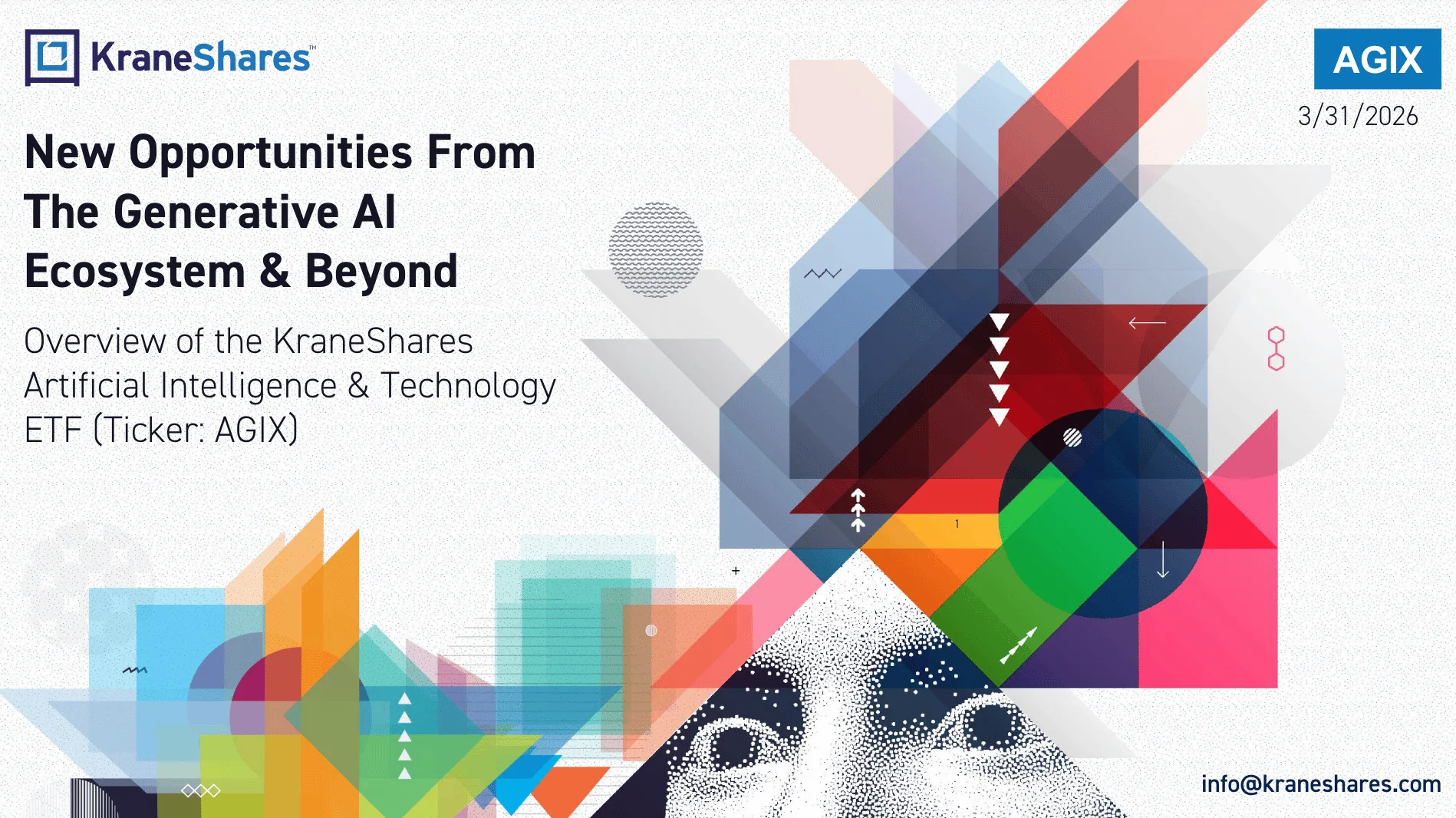
Amr Amin: Salam alaikum. Hello everyone, and thank you all for joining us today. We're delighted to welcome you to this session introducing the KraneShares Artificial Intelligence and Technology ETF, or AGIX, now available on the Abu Dhabi Securities Exchange.
My name is Amr Amin, and I lead corporate relations at the ADX, where we work closely with listed companies and market participants to enhance investor engagement and support the continued development of Abu Dhabi's capital markets.
At the ADX, a key part of our strategy is to continuously broaden the range of investment opportunities available to investors, particularly through innovative products that provide access to global themes in a transparent and accessible way. In recent years, this has included expanding our ETF offering and introducing products that go beyond traditional exposures, allowing investors to participate in structural growth trends shaping the global economy.
Artificial intelligence is clearly one of the most significant of those themes today, and AGIX represents a compelling way to access that opportunity — combining exposure to leading public companies with selective access to private high-growth innovators, all within a liquid ETF structure.
Our goal for today is to keep the discussion practical and accessible, and to help you better understand what AGIX is, how it works, and how it may fit into an investment portfolio.
A couple of quick housekeeping points: the session is being recorded and will be shared after the event. If you have any questions during the discussion, please feel free to submit them through the Q&A function, and we'll aim to address as many of them as possible.
I'm joined today by an excellent panel of speakers representing different parts of the ecosystem behind AGIX. We have Emil Tarazi, co-founder at Oceane Invest and Nukoud.com, and from KraneShares we have Derek Yan, CFA, Senior Investment Strategist. Before we dive in, I'd like to give each of our speakers a moment to briefly introduce themselves.
Emil Tarazi: Thank you, Amr, and thanks everyone for joining today. As Amr mentioned, I'm co-founder at Oceane Invest. We are a market maker and liquidity provider on the Abu Dhabi exchange. My role is heading up the trading operation as well as technology at Oceane.
Derek Yan: Hello, everyone. My name is Derek Yan. I'm a Senior Investment Strategist at KraneShares. We're a US-based asset manager — we manage over 30 strategies, giving global investors access to our high-conviction investment opportunities. I do research and product design at KraneShares, and communicate with our investors globally.
Amr Amin: Thank you. It's a pleasure to have you here, Emil and Derek.
The Scale and Significance of AI as an Investment Opportunity
Amr Amin: To start us off, can we talk about artificial intelligence as the next major technological wave? How should investors think about the scale and significance of this opportunity today?
Derek Yan: Thank you for the question. For most investors, the question isn't whether AI is a real investment opportunity — it's how to position around it.
Just look at the numbers today. AI capex by hyperscalers has grown from over $100 billion to over $400 billion last year, potentially reaching $700 billion this year. That's a number we haven't seen in decades. That proves AI is not really a new sector — it's like railways, like electricity. It's an investment opportunity that emerges not over many years, but over several decades.
If you think about it that way, we're still in the early stage of AI. We're at the very early installment phase of the AI infrastructure. The progress in large models is so fast that the new generation of models — like Mythos — could break down critical infrastructure in the US, to the point where the White House and the Fed are worried about the impact.
When you have those kinds of developments coming, this is potentially an investment opportunity bigger than anything in your or my lifetime. That's why we believe investors should fully understand how to invest in this AI opportunity.
Shift from Experimentation to Enterprise Adoption
Amr Amin: You brought up infrastructure, and I think that's also an interesting angle. We're seeing a shift from early experimentation to broader enterprise adoption. What does this mean in terms of long-term investment opportunity?
Derek Yan: This is so early. Investors really realized this opportunity when ChatGPT became popular — that was 2023 to 2024. During that period, most people thought AI was a chatbot, conversation-based.
When we launched AGIX, we hosted a panel discussion with a team member from Anthropic, and they believed enterprise was actually a bigger opportunity than the chatbot. That has now turned out to be true.
If you think about the nature of AI, it's intelligence — digital intelligence — that can potentially replace physical labor. Going forward, you're going to increasingly have more digital employees. I just recently read news about a one-person company reaching $1 billion in annual recurring revenue. We're going to keep seeing those moments. Digital employees will gradually take on enterprise functions, replacing some employees and automating a lot of workflows.
That trend is not overnight, but over the next 5 to 10 years it can fundamentally restructure how human productivity works. The opportunity over the next 5 to 10 years is way bigger than a small chatbot — imagine, everything we do today can potentially be disrupted. That's why it's extremely important to position your investment around enterprise adoption.
What AGIX Is and What It's Designed to Do
Amr Amin: To bring it back to the product — what exactly is AGIX, and what is it designed to provide investors?
Derek Yan: This is such an early stage of the opportunity, which makes it very dynamic. Investors should take a holistic approach to investing in AI.
AGIX allows investors to invest in the whole ecosystem of AI — across hardware, infrastructure, and applications — but most importantly, into the large models. Those model companies are the epicenter of the opportunity, because they're disrupting and transforming applications, driving the shortage in computing infrastructure, and ultimately the shortage in hardware.
That's something most investors are missing by simply investing in the NASDAQ or the S&P, because those leading model companies are private. For AGIX, we invest not only in the public AI companies, but also in companies like Anthropic and xAI (which became part of SpaceX). Ten or twenty years ago, those companies would already have IPO'd, but today they're still private — and investors are missing them in their portfolios. AGIX bridges that gap and gives investors access to companies like Anthropic and xAI.
Active Management Approach
Amr Amin: As an ETF, is AGIX actively managed rather than simply tracking an index? How should investors think about the difference in practice?
Derek Yan: Yes, AGIX is actively managed — but not the active management people typically think of. It's not day trading.
For the public sleeve, it's actively managed because you want to be AI-native. The dynamic between hardware, infrastructure, and applications needs to be systematically managed. We leverage an AI score that comes from AI-native researchers and venture investors who do research on large language models every day. They understand the market dynamic — what's happening around the model space, and how those models are going to impact each layer of the stack.
That AI score dictates our public equity exposure. On the private side, it's also active management, because that depends on conviction and deal flow. Using that approach, we think this is very different from a traditional thematic passive index. There are inputs we think are critical for long-term positioning to this AI trend, and that's how AGIX is differentiated from most other AI ETFs on the market.
Who Are Oceane and Nukoud?
Amr Amin: AGIX is listed on the ADX, but we've also heard names like KraneShares, Oceane, and Nukoud. Emil, can you start by explaining who Oceane and Nukoud are?
Emil Tarazi: Absolutely. To make ETFs happen, you need a lot of different ecosystem players. Derek represents the ETF and asset management side and the portfolio construction. Oceane is an Abu Dhabi-based company — we are liquidity providers. The exchange represents the marketplace, and we are participants in that market.
As Oceane, we'll be sitting there quoting throughout the day and pricing this ETF during ADX regular market hours. Most likely, if you're ready to buy or ready to sell this ETF, we'll be on the other side ready to take the other side of the position. If you're buying, we'll be selling; if you're selling, we'll be buying.
This function is quite important. The ETF concept has been very successful over the last 30 years partly because of this all-day liquidity — there are market makers and liquidity providers like Oceane willing to sit there, take the risk, and facilitate the other side of the order.
On this slide you can see the different market participants. We're at the top left — "market maker / liquidity provider." They're slightly different functions, but essentially we're ready to buy and sell ETFs.
A quick note on the growth story: ETFs are an incredible product for investing and for expressing your view on the market. ETFs have experienced over 15% growth year-over-year for many years now — perhaps more than 15 years. In the US and Europe, the story is incredible: over $19 trillion in assets across these markets. In the US, there are over 5,000 products with an incredible pace of new launches — maybe one, two, or three new ETFs coming to market every single day. Europe has over 3,000 products. ETFs trade on almost every exchange around the world.
In the GCC, we've seen ETFs grow, but not very rapidly. Oceane's role is to help catalyze that growth. As context: globally there's about $19 trillion in ETFs, while there's roughly $2 billion in locally listed products across GCC countries — namely the UAE and Saudi, with some in Qatar and Kuwait as well. We plan on providing more and more liquidity to facilitate cross-listed products like AGIX (traded on the New York Stock Exchange and now cross-listed on the ADX), but also to bring more liquidity to local products.
A quick note on Nukoud: ETFs represent many different ways to invest — you can invest in your local UAE or Saudi market, in commodities like gold, more recently in crypto, and even in leveraged products that give more exposure to indices, broad markets, or single stocks. Investors want and demand these products, and we as Oceane will be bringing more of them to the region.
But because there is so much diversity in ETFs, the educational component is quite important — the ability for users to get data, understand what these products do, what the costs are, what the historical returns are, and find this information quickly. That's why we built Nukoud. The website is nukoud.com — nukoud in Arabic means money — and the site is focused on ETF investing and wealth creation across the Gulf and the GCC.
Very recently — just last week — we partnered with Morningstar, a large provider of high-quality data and analytics on ETFs and funds. We'll be bringing more of that data to the Nukoud website with a focus on local products. If you go to the site today, you can log in and see information on the 40-plus ETFs across the region. The recording of this webinar will also be linked at the top right on the main page so you can replay it later.
Amr Amin: That's very helpful. So Oceane handles market making and development, while Nukoud is an educational platform for research and news on ETFs in the GCC region.
KraneShares' Role as ETF Sponsor
Amr Amin: Where does KraneShares come in? Derek, can you help us with that?
Derek Yan: Of course. KraneShares is the ETF manager — the sponsor of the ETF. We have a suite of ETFs we list here in the US, and now we have this opportunity to partner with local partners in Abu Dhabi and list on the ADX. We provide global investors access to investment opportunities we identify.
That's the beauty of an ETF. As Amr said, the ETF is probably the most popular investment vehicle today — especially for investors here in the United States — for several reasons:
- Transparency — you have full holdings every day. You know what you're investing in. Even for our private holdings, you know how many shares of Anthropic you hold, how many shares of SpaceX you own. That's published on kraneshares.com/AGIX every day.
- Tax efficiency — unlike mutual funds, where redemptions can trigger capital gains or losses, ETFs use in-kind creation/redemption, which can be a more tax-efficient solution.
- Simple fee structure — no 12b-1 fees or upfront loads. The fee structure is straightforward.
That's the benefit of ETFs generally, and we believe this is very catering to everyday investors. Even for access to private markets — traditionally investors used private funds or venture funds with seven-to-ten-year lock-ups, high minimums, and high bars for entry. With an ETF, this is daily liquid; you can buy any number of shares, and it's transparent. We think this democratizes private markets through ETF innovation.
That's how KraneShares operates. We invest in all kinds of investment opportunities. Our founder, Jonathan Krane, believes that providing unique access to investors through ETFs is very important — and that's how AGIX is going to serve our investors here on the ADX.
The AI Exposure Score and Stock Selection
Amr Amin: In the AGIX material we've seen, there's a structured approach to selecting companies using an AI exposure score. Can you walk us through how that works in simple terms?
Derek Yan: In simple terms — traditional thematic ETFs, index ETFs, or even active managers and buy-side analysts often look at things like how many times "AI" is mentioned, or whether a company has "AI" in its description. We don't think that really works.
For the next generation of AI disruption, you have to look at how the large language model is integrated into a company's business model — how many AI agents they're using to replace workflows. Those things are more AI-native, which is why we partnered with someone with that specialization: our sub-advisor, Etna Capital.
We use those insights to build a score. We look at things like: how much revenue is the company generating from AI? What's the progress of its product? Is its business model ready for the next generation of models? What's the visibility of AI revenue, given AI model disruption? All of those things transform into a score that we apply to companies each quarter, dynamically positioning the ETF for the current phase of AI innovation.
We've created an index to systematically represent that public equity exposure. So far, we've outperformed the NASDAQ since we launched the fund — and the fund overall has outperformed the index because of the private holdings. Using this approach is very systematic, but incorporates insights from people who actually know AI. We think that's a better approach than just keyword matching or "AI-theater" companies — that's a little outdated for the next generation of AI investment.
Amr Amin: So these are the mechanisms you're using to go from a broad universe of companies down to the final portfolio?
Derek Yan: Exactly. The starting universe is global — three to four thousand companies that meet a certain liquidity and market cap threshold. We then narrow down to AI-focused sectors, which still leaves 500 or 600 companies. The AI score then kicks in: who is going to be critical for large model integration? Whose business model is bulletproof for the next generation of disruption? How does the company benefit from AI shortages in hardware and computing infrastructure? Those are the things AI-native researchers look at when providing the score that positions the ETF.
The portfolio today on the public side has 50 to 60 holdings based on that score, and the process is run quarterly, so it keeps reflecting the latest portfolio that's positioned to benefit from AI long-term.
Public + Private Company Exposure
Amr Amin: One of the unique aspects of AGIX is its exposure to both public and private companies — Anthropic, SpaceX. Can you explain how that works and why it matters?
Derek Yan: At a high level, AGIX is a US-domiciled '40 Act fund. For a fund like that, we can invest up to 15% in illiquid assets — that's SEC-approved. Using that 15%, we can invest in companies like Anthropic (private shares) and xAI.
There are several approaches to private investment. One is participating in primary round financing — we talk to them directly. Another is tender round offerings. We get direct access, so AGIX (on behalf of the trust) is actually a shareholder of Anthropic and xAI — which, after the merger, automatically became SpaceX. We're on the cap tables of both companies. It's transparent — we own those shares, and they're in the fund.
The question then is: AGIX is daily liquid, so how do we provide a daily net asset value? We have to assign a fair value to those private companies — they don't have a stock price, so we have to give them one. We consider several things:
- The primary round financing valuation is the anchor, the baseline daily price.
- Between primary rounds, there are many secondary market transactions. We use data vendors to monitor those secondary transactions and adjust accordingly through our internal fair value committee.
Every day we meet, discuss, and sign off on the fair value for the private companies. That's how we have a daily NAV. The process is verified by our third-party auditor, KPMG, and follows industry-standard practices. Using that approach, we've unlocked access to private companies through a daily-liquid vehicle that everyone can invest in. It's complicated, but very transparent.
Capturing the Full AI Value Chain
Amr Amin: The ETF is positioned across the full AI value chain — hardware, infrastructure, applications. Why is it important for AGIX to capture all three segments?
Derek Yan: Because AI is a decade-long — or decades-long — investment opportunity. You can't simply bet on one thing. Value is going to migrate from hardware to infrastructure and eventually to applications. That process can be very dynamic.
This is similar to any generation of technology breakthrough — railways, electricity, the internet. First, capital concentrates heavily in infrastructure and hardware: facilities like data centers, GPUs. The second tier includes memory, batteries, optical and power. Those are the things happening right now.
Once those are ready, value migrates to the computing side: the cloud, neoclouds, data preparation, model monitoring, all the deployment infrastructure for large language models. We're at the inflection point where things could move toward enterprise model deployment. There's a lot of opportunity there — many business models will be transformed, and the companies that benefit are largely underpriced today.
A holistic approach to capturing each layer of the stack is more balanced and sustainable than betting on one niche sector, which can be cyclical. A diversified but thoughtful approach to each layer of the stack — and capturing the foundational models, which are private — gives investors exposure to the whole AI ecosystem. No matter how value migrates, you're capturing it along the way.
Performance vs. Benchmarks
Amr Amin: That also speaks to how AGIX is differentiated from traditional technology ETFs. Let's talk about performance — how does AGIX differ from benchmarks like the NASDAQ 100 in composition and exposure?
Derek Yan: Using our framework, we end up with very differentiated positioning compared to the NASDAQ 100. Over half of AGIX's holdings are not in the NASDAQ 100. We have international players, neoclouds like Nebius, undervalued cybersecurity companies, energy companies that benefit from computing-driven demand, memory chips — companies that aren't in NASDAQ 100 are in AGIX.
Since inception, we've outperformed the NASDAQ. From inception in July 2024 through a recent weekend, AGIX has returned roughly 56%. Our underlying index — the Solactive Etna AGI index, which uses the AI researchers' scores — has outperformed the NASDAQ 100 by 9.3% since inception. The fund itself has outperformed our public equity sleeve by about 10% because of the private holdings.
Anthropic's revenue grew from around $1 billion at the end of 2024 to recently announced over $30 billion in annual revenue. That investment has been astonishing since we invested in Anthropic in February 2025 in their Series E round at a $61.5 billion valuation. Today, investors are talking about Anthropic potentially being larger than OpenAI in valuation. Same story for xAI — we invested in July 2025 in their tender round and added more in December via another series round.
That private exposure has driven outperformance over our public equity benchmark and well over the NASDAQ 100. Both public and private have contributed value, validating our thesis: investors should not only invest in public AI companies, but also capture value creation from the private side. A more balanced public-and-private approach should add value over time — just as institutional investors have done for decades. Traditional institutional investors typically allocate 8–13% to VC, which is similar to our target in AGIX. Endowments, foundations, and pensions do this for diversification and potential added performance.
Q&A: Expense Ratio and Dividends
Amr Amin: Let me bring in some questions from the chat. Several are asking about the expense ratio for AGIX and whether it pays dividends.
Derek Yan: Our expense ratio — covering both public and private — is 0.99% (99 basis points). Compared to an S&P or NASDAQ ETF that may seem high, but compared to traditional private equity or venture capital funds (which usually charge 2 and 20, with carry), or interval funds (also high-fee), our fund sits in the middle. Using this framework, we believe we're creating unique access at a reasonable fee.
On dividends — AGIX is more growth-oriented; it's not a dividend-heavy strategy. The companies in the fund are growth companies, so dividends are minimal. Over the last two years, distributions have been very modest.
Q&A: Private Company Valuation Process
Amr Amin: Another question: since private company valuations aren't market-verified, is there a risk that performance might be overstated? Can you talk more about the mechanics?
Derek Yan: We're being very conservative — we're not just assigning whatever valuation we believe. We have very solid, observable data points: the valuation institutional investors give those companies in primary round financings, plus secondary market transactions between primary rounds (showing at what valuation people are buying and selling). Those are high-conviction, observable data points — what we'd realistically receive if we sold today.
It's nothing controversial; it's industry best practice. We believe investors are getting a fair price, and we communicate the fair value process with our auditor KPMG very often to make sure we're following best practice for investors globally.
Q&A: A Sharia-Compliant Version?
Amr Amin: About a week ago we held a similar webinar for KWIN, a Sharia-compliant Islamic fund. This question is for KraneShares: are you planning to launch a Sharia-compliant ETF with similar exposure to Anthropic and xAI?
Derek Yan: If there's strong demand, that's an obvious option. We can consider it. This is our commitment to this market. KWIN was first, AGIX is next, and we potentially have more coming. We always welcome those suggestions and ideas, and we're going to keep launching more products here on the ADX.
Q&A: Why Now for the Region?
Amr Amin: Given the current geopolitical situation, why is now a good time to introduce these ETFs to investors in this region?
Emil Tarazi: I think it's always a good time. As I mentioned, ETFs help you express your view on where the market is heading. We've observed that volumes and trading activity on the ADX have increased over the last few months — more people are trading and want to position their portfolios for where things are going. If anything, there should be more funds coming to the market faster, to give investors more opportunities to express those ideas.
There are a lot of themes happening around AGIX. As Derek mentioned, AI is another industrial revolution. This is a very interesting product giving direct exposure to some of the most exciting companies in AI. Is it driven by investor demand? Absolutely. Everything sponsors and asset managers like KraneShares do is driven by interest from the market, and everything we do as market makers is driven by investor demand. It's about bringing all those pieces together — the time is now.
Key Risks and Suitable Investor Profile
Amr Amin: From a balanced perspective, what are the key risks investors should be aware of, and what kind of investor is this product best suited for?
Derek Yan: AI companies are, by nature, growth companies. So for investors looking for capital growth over the long term, this is probably the most significant long-term structural change creating that growth exposure. But investors should be aware that growth investing comes with volatility. We've seen that volatility over the last few years — often driven by geopolitical risk.
Given that AI companies are doing well, their valuations are not deep. So when geopolitical events happen — like Liberation Day a year and a half ago — there can be drawdowns. But when geopolitical risk and risk sentiment normalize, those AI companies tend to recover sharply, as we've seen recently.
In the long term, AI is going to be very sustainable and drive structural growth, but along the way there will be volatility. Investors with that risk-return profile will find this a good match.
Oceane's Market Making Role and Cross-Listing
Amr Amin: Emil, can you explain more about Oceane's role in ensuring efficient trading — for AGIX specifically and ETFs in general?
Emil Tarazi: ETFs are about transparency. As Derek mentioned, one of the key innovations is daily pricing and disclosure of fund holdings. As market makers, we look at what the fund holds — every single line item — and we price it. We want to make sure that the price of the ETF (the wrapper around all those holdings) reflects the average weight of those holdings.
We do that with live market data, looking at the price of each item. This is an international basket comprised of both public and private stocks. About 70% of the basket is exposed to US listings — and the US market is closed during ADX market hours. It's our job as market makers to figure out where Nvidia is when the US market is closed.
We do that in various ways. Increasingly, trading is happening 24 hours a day, so we can look at where Nvidia is trading in the overnight session. We can look at futures markets and where Asian or London markets are, and build estimates around pricing. Getting that pricing right is very important. How do we know we're right? Because we can observe prices throughout the day. At the end of the Abu Dhabi trading session, the US market opens about half an hour later, and we can check our pricing and calibrate every day going forward.
That's the core function. We use all those markets to source liquidity. Liquidity on the ADX is very dependent on global liquidity, and Oceane is the bridge between all those markets. As an individual investor, you may not be able to trade private stocks or have access to the US, Hong Kong, or London markets — and you may not want to do that in your own account. But we, as an institutional partner in this ETF ecosystem, have the technology and connections to all those exchanges and brokerages worldwide. That combination of technology and pricing expertise ensures there's a good, liquid price on the ADX for AGIX in the Abu Dhabi time zone.
Amr Amin: In simple terms, how does this benefit UAE-based investors? What is the advantage of AGIX being cross-listed?
Emil Tarazi: Having multiple listings is good — it means you can take a product and trade it on different exchanges if you really want to. But fundamentally, this is about market access. It's about developing the ETF ecosystem, giving investors access to products to express their views and build wealth long-term. It's about more tools to express your views on the market.
Tax Considerations
Amr Amin: A practical question from the chat: what tax implications should non-US investors be aware of, particularly on dividends?
Derek Yan: Just to add context — as I mentioned, AGIX is more growth-oriented; it's not a dividend-heavy strategy. The dividend over the last two years has been minimal. But on the tax side, Emil can speak to local investor specifics.
Emil Tarazi: If a product is US-listed and has a dividend distribution, there is a 30% withholding for non-US investors. That's for cross-listed products that distribute. KWIN, mentioned earlier, is an accumulating product — it has a built-in return mechanism but doesn't distribute, so it doesn't face the same withholding penalty in the US.
To be clear, as Oceane we want to support all ETFs. We're bringing US-listed products to the ADX, but we're also looking at bringing in European UCITS products that may have lower or no withholding on distributions. Those will be coming soon as we work with different asset managers and issuers in the region.
Amr Amin: That's helpful. So investors will have access to a wider array of ETFs, each with different profiles and mandates, and AGIX is one option focused thematically on AI — with the awareness that it may be subject to withholding tax.
Closing Thoughts
Amr Amin: One last question before we close. If each of you had to describe AGIX in a single sentence, how would you do it?
Derek Yan: It's a ticker — AGIX. AI-native investors love it: AGI is the future they're working toward. The "X" is access — you get access to the most innovative companies, like Anthropic and xAI (now part of SpaceX, also building AI alongside satellite launches and Starlink) — critical future infrastructure. In one sentence: AGIX is a public-and-private, AI-native approach to investing in AI.
Emil Tarazi: I'd say this is the easiest way to join the AI revolution. In my daily life, I use all these products quite a bit — if you looked at my usage as a stock chart, it would be straight up to the top right. These products are revolutionary; they're changing the way we run our business. We use Anthropic products. I use Grok from xAI. We're really at the very beginning of this. As Derek mentioned, this is a growth product, and it's about getting easy exposure to these very interesting names — including the publicly listed enterprise-focused names like Nvidia. It's quite an important product.
Amr Amin: Thank you, Emil. Thank you, Derek. Thank you again to our panelists for the insightful discussion, and thank you to everyone who joined us today. We hope this session has provided a clear, structured understanding of AGIX — from the broader AI opportunity to how the ETF is constructed and how it may fit within an investment portfolio. We look forward to your participation and to continuing the conversation around innovative investment opportunities on the ADX.
Have a great rest of the day, everybody.
Emil & Derek: Thank you.